
Pay Per Click Strategies in South Africa: How Web Infrastructure Reduces CPC

Running pay-per-click (PPC) campaigns without optimising where that traffic lands is the fastest way to bleed capital in B2B marketing. Many business owners blame the ad platform when campaigns fail to yield results. They adjust keywords, swap campaign settings, or raise daily budgets. Yet the ad account is rarely the primary failure point. When you purchase clicks on Google or Meta, for example, you buy temporary access to attention. If that attention lands on a slow, confusing, or poorly structured website, your ad spend evaporates. The High Cost of Unoptimised Destinations Average search clicks in South Africa range from R5 to well over R50 in competitive B2B, financial, and professional services sectors. High-competition keywords can push significantly higher. If your website converts only 1% of visitors because pages load slowly on mobile devices or hide contact forms beneath paragraphs of text, every lead costs you a fortune. How Search Engines Tax Bad Web Infrastructure Ad platforms operate on complex auction models that prioritise user experience alongside bid amounts. Google, for example, measures landing page experience, page load times, and search relevance to calculate a Quality Score. When your receiving page is technically flawed, search algorithms respond in two ways: Fixing your destination architecture lowers your effective CPC. High technical performance rewards you with lower ad costs. The Three Pillars of PPC-Ready Web Architecture To stop wasting capital on paid traffic, your website infrastructure must fulfill three core operational standards before you launch or scale paid campaigns: 1. Speed and Mobile Optimisation A large percentage of local traffic browses on mobile devices, often over constrained cellular networks. A page that takes five seconds to load loses half its traffic before the content even renders. Minimal code bloat, clean assets, and optimised server responses are non-negotiable prerequisites for paid campaigns. 2. Message Match and Frictionless Layout When a user clicks an ad for “Commercial Industrial Plumbing Durban,” the landing page must immediately echo that exact service offering above the fold. Generic homepages scatter user focus. A dedicated, high-intent page removes navigation clutter, presents proof points, and provides an immediate path to action. 3. Objective Measurement and Telemetry You cannot optimise what you do not measure accurately. Your web architecture must feature server-side event tracking to capture real enquiries, phone calls, and WhatsApp engagements without relying on vulnerable client-side scripts. Clean data feeds the platform’s machine learning, teaching ad networks to find higher-value prospects over time. Engineering Your Conversion Engine First Paid ads are a powerful traffic amplifier, but an amplifier only makes the underlying signal louder. If your web infrastructure is quiet, confusing, or broken, scaling ad spend simply multiplies your operational waste. Before increasing your digital advertising budget, inspect the receiver. Build a technical foundation that loads fast, matches user intent, and converts clicks into real commercial equity.
How to Turn Social Media Into a Predictable Source of Business Enquiries

A successful social media marketing strategy is not just about being consistent with your posts, boosting the occasional one, and watching your followers increase. Your phone is not going to ring off the hook. Don’t worry, the problem probably isn’t your content, but rather what happens after people see it. Social Media Is Not Your Sales Department Many business owners expect social media to do everything. They want it to: That’s asking one marketing channel to perform every job in your business, and social media was never designed for that. Its primary purpose is to capture attention and encourage the next step. What happens after that determines whether attention becomes revenue. Activity Isn’t the Same as Progress It’s easy to measure social media activity. You can count: Those numbers feel encouraging, but none of them pay salaries. The metrics that do matter are: A business with 500 followers and regular enquiries is in a stronger position than one with 50,000 followers and no consistent sales. Attention without conversion is simply expensive entertainment. Why Many Social Media Strategies Fail Many businesses focus almost entirely on producing content and that’s understandable because it’s the visible part of marketing. What people don’t see is the system underneath. Think of social media like a highway. It can bring vehicles towards your business, but if every road leads to a dead end, traffic doesn’t create revenue. It simply creates congestion. Without a structured destination, your marketing keeps attracting visitors who never become customers. Every Post Should Lead Somewhere Imagine seeing an advert for a new restaurant. You become interested, you visit the location, but there’s no entrance, no menu, and no staff. Eventually you’ll just leave. That’s what many businesses unintentionally create online. People discover them through social media, but they land on a website that loads slowly, explains very little, or gives no clear next step. Fair enough, the social media campaign did its job, but the business’s holistic digital infrastructure didn’t. Consistency Still Matters None of this suggests social media isn’t important. It absolutely is. Consistent posting helps businesses: The mistake is expecting those activities alone to produce predictable growth. The strongest businesses combine consistent content with a structured customer journey that makes it easy to take the next step. Think Beyond Individual Posts Instead of asking, “What should we post this week?” Ask, Those questions shift social media from content creation to business development. Growth Happens When Every Part Works Together Social media is one component of a much larger system. It introduces your business. Regarding the rest of the system: When those pieces work together, marketing becomes more predictable, but when they don’t, businesses often mistake low sales for poor social media performance. In reality, the content was never the problem, the system was. Posting more rarely fixes a broken customer journey. Improving the system usually does. * Editorial Note: Visual assets within this Intelligence Briefing were generated using advanced machine intelligence under human strategic governance to creative purposes.
Your Website Isn’t Broken. It’s Just Doing the Wrong Job.
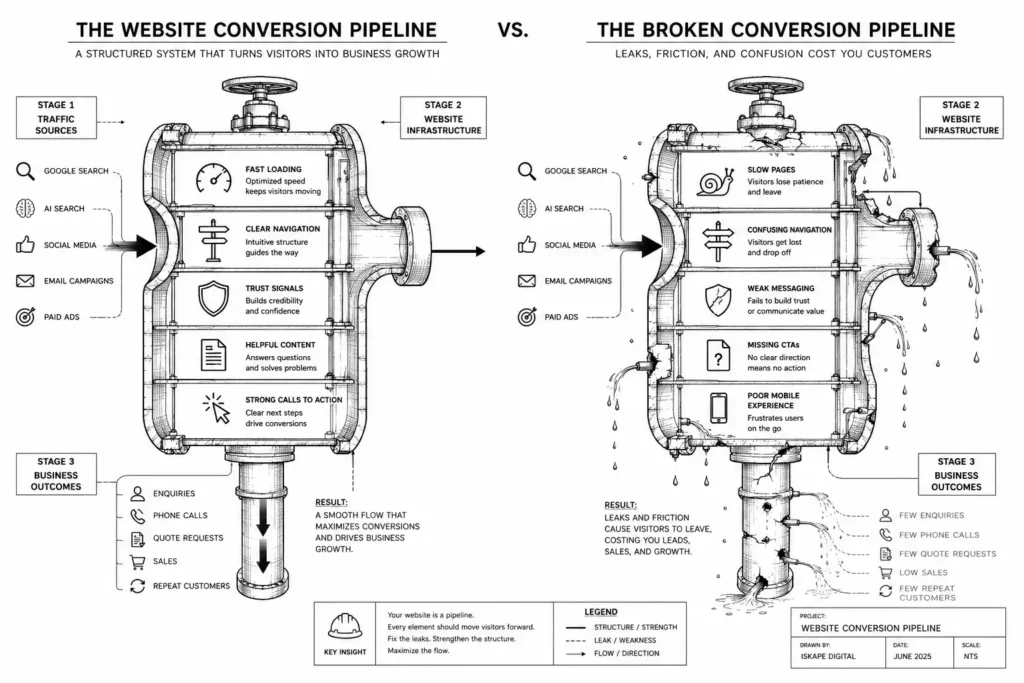
Many business owners think a website exists simply because every business should have one, but that thinking costs money. A website isn’t digital stationery, it isn’t an online brochure, and it certainly isn’t something you build once and forget. Its primary job is simple: Reduce the effort required for someone to become your customer. If it fails at that, it isn’t doing its job. The Most Expensive Mistake SMMEs Make SMMEs across South Africa invest in a new website daily, some of which can cost tens of thousands of rands. The website seems to tick every box: Six months later though, nothing has changed. Your business has still not grown to levels you were expecting. You could blame Google, or Facebook, or the economy. In reality, the website was never designed to generate enquiries in the first place. It was designed to look impressive. Those are two completely different objectives. Attractive Doesn’t Mean Effective Many template-based websites focus almost entirely on appearance, but customers judge something very different. They subconsciously ask questions such as: Every unnecessary click increases doubt, every confusing page increases friction, and every second of waiting encourages visitors to leave. A website should remove uncertainty – not introduce it. Think of Your Website Like Your Reception Area Imagine a customer walks into your office, but nobody greets them, there are no signs, the receptionist disappears, and every office door is closed. What will happen with that customer? Eventually they walk out, and that’s exactly what happens on many websites. Visitors arrive ready to learn more, but they can’t find the information they are seeking quick enough. Every Marketing Channel Depends On Your Website Many businesses believe social media, Google Ads or email marketing are responsible for generating sales. They’re only responsible for generating attention. Your website determines what happens next. Think of every marketing activity as a road leading somewhere. If every road ends at a confusing destination, the traffic becomes wasted spend. That’s why businesses often experience this cycle: The real bottleneck wasn’t the advertising, it was the destination. Good Websites Remove Buying Friction Customers don’t enjoy working hard, and the easier you make their decision, the more likely they are to contact you. A well-structured website should answer questions before they’re asked, it should make pricing, services, credibility and contact options easy to find, and it should also perform consistently on mobile devices. This matters even more in South Africa, where mobile browsing dominates and network quality varies significantly. A slow website isn’t just inconvenient – it actively loses business. Your Website Is Part of a Bigger Growth System The highest-performing businesses rarely rely on one marketing channel, but instead, they build connected systems. In these connected systems, search visibility attracts visitors, email marketing keeps conversations alive, paid advertising accelerates growth, and social media builds awareness. Your website connects every one of these activities. Without that central foundation, each channel operates independently, making growth slower, less predictable and more expensive.Growth becomes easier when every part of the system works together. Questions Worth Asking Ask yourself this question: If my website disappeared tomorrow, would my enquiries stop? If they would not stop, your website may not be contributing much value. Consider these questions to ascertain how much value your website is actually contributing: If several answers are “no”, the issue probably isn’t your marketing budget.It’s your website’s underlying structure. Businesses don’t grow because they have websites, they grow because their websites remove friction and help customers make confident decisions.