
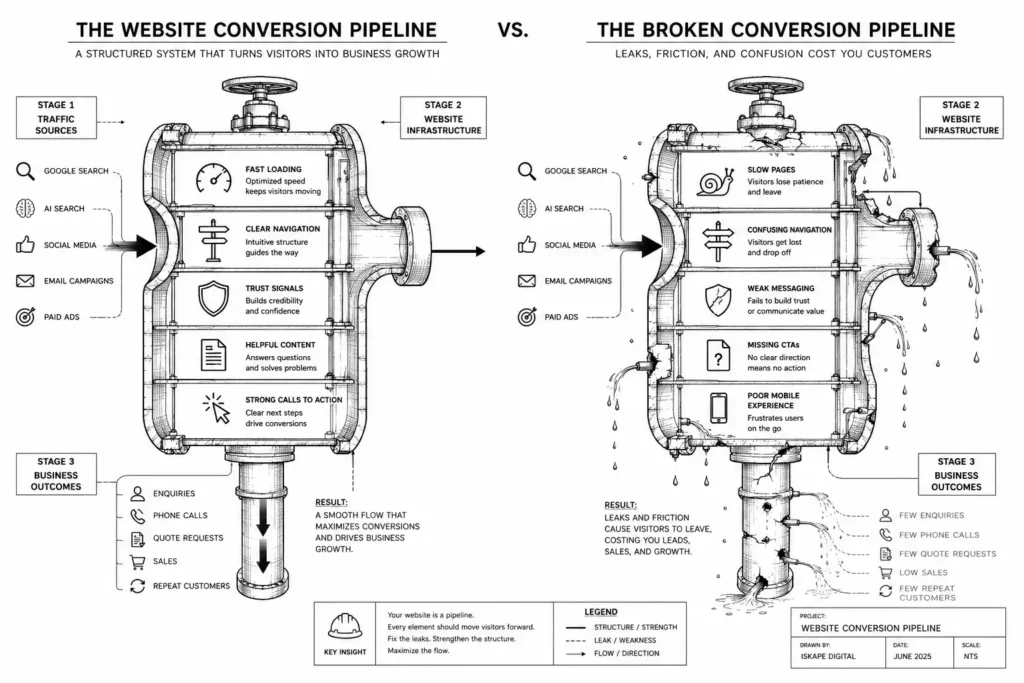
Many business owners think a website exists simply because every business should have one, but that thinking costs money. A website isn’t digital stationery, it isn’t an online brochure, and it certainly isn’t something you build once and forget.
Its primary job is simple: Reduce the effort required for someone to become your customer. If it fails at that, it isn’t doing its job.
The Most Expensive Mistake SMMEs Make
SMMEs across South Africa invest in a new website daily, some of which can cost tens of thousands of rands. The website seems to tick every box:
- It looks modern.
- The colours are attractive.
- The photographs are professional.
Six months later though, nothing has changed. Your business has still not grown to levels you were expecting. You could blame Google, or Facebook, or the economy. In reality, the website was never designed to generate enquiries in the first place. It was designed to look impressive. Those are two completely different objectives.
Attractive Doesn’t Mean Effective
Many template-based websites focus almost entirely on appearance, but customers judge something very different. They subconsciously ask questions such as:
- Can I trust this business?
- Can I find what I need quickly?
- Is this company credible?
- What should I do next?
- Is contacting them worth my time?
Every unnecessary click increases doubt, every confusing page increases friction, and every second of waiting encourages visitors to leave.
A website should remove uncertainty – not introduce it.
Think of Your Website Like Your Reception Area
Imagine a customer walks into your office, but nobody greets them, there are no signs, the receptionist disappears, and every office door is closed.
What will happen with that customer? Eventually they walk out, and that’s exactly what happens on many websites.
Visitors arrive ready to learn more, but they can’t find the information they are seeking quick enough.
Every Marketing Channel Depends On Your Website
Many businesses believe social media, Google Ads or email marketing are responsible for generating sales. They’re only responsible for generating attention. Your website determines what happens next.
Think of every marketing activity as a road leading somewhere. If every road ends at a confusing destination, the traffic becomes wasted spend.
That’s why businesses often experience this cycle:
- Spend more on advertising.
- Generate more visitors.
- Receive the same number of enquiries.
- Increase advertising again.
The real bottleneck wasn’t the advertising, it was the destination.
Good Websites Remove Buying Friction
Customers don’t enjoy working hard, and the easier you make their decision, the more likely they are to contact you. A well-structured website should answer questions before they’re asked, it should make pricing, services, credibility and contact options easy to find, and it should also perform consistently on mobile devices.
This matters even more in South Africa, where mobile browsing dominates and network quality varies significantly.
A slow website isn’t just inconvenient – it actively loses business.
Your Website Is Part of a Bigger Growth System
The highest-performing businesses rarely rely on one marketing channel, but instead, they build connected systems.
In these connected systems, search visibility attracts visitors, email marketing keeps conversations alive, paid advertising accelerates growth, and social media builds awareness.
Your website connects every one of these activities. Without that central foundation, each channel operates independently, making growth slower, less predictable and more expensive.Growth becomes easier when every part of the system works together.
Questions Worth Asking
Ask yourself this question: If my website disappeared tomorrow, would my enquiries stop?
If they would not stop, your website may not be contributing much value.
Consider these questions to ascertain how much value your website is actually contributing:
- Can visitors understand what we do within ten seconds?
- Is the next step obvious?
- Does every page encourage action?
- Does the site perform well on mobile?
- Does it support every marketing campaign we run?
If several answers are “no”, the issue probably isn’t your marketing budget.It’s your website’s underlying structure.
Businesses don’t grow because they have websites, they grow because their websites remove friction and help customers make confident decisions.